Which Samsung Galaxy Watch is best? How to choose the right one
Which Samsung Galaxy Watch is best? How to choose the right one
Samsung now has so many Galaxy Watch models that choosing has become genuinely tricky. Watch 9, Watch Ultra 2, Watch 8 Classic, Watch 8 or the more affordable Watch FE: they look similar, but differ considerably in battery life, size and price. There is no single answer to "which Samsung Galaxy Watch is best". It depends on how you use your watch and how much you want to spend.
To point you in the right direction: for most people, the Galaxy Watch 9 is the best choice. If you train seriously or spend time outdoors, the Galaxy Watch Ultra 2 is a better match. If you want to keep costs down, the Watch 8 or Watch FE will serve you perfectly well. Read on to find out exactly why, along with answers to any other questions you might have.
Our recommendation in brief
-
Not sure where to start and just want a solid, up-to-date smartwatch? Go for the Galaxy Watch 9.
-
If you train seriously, hike in the mountains or do some diving, go for the Galaxy Watch Ultra 2.
-
Prefer a classic look with a rotating bezel? Go for the Galaxy Watch 8 Classic. If you mainly want to count steps and see notifications without spending too much, the Watch 8, Watch FE or a Galaxy Fit will do the job nicely.
The best Samsung Galaxy Watch for every situation
Want the latest and greatest? Choose the Galaxy Watch 9
The Galaxy Watch 9 is Samsung's most recent model and the obvious choice if you simply want the best of what's available now, without extreme sporting ambitions. It runs on a new Snapdragon chip and comes in two sizes: 40 mm and 44 mm, so it fits both slimmer and wider wrists. This is the Samsung Watch to go for if you want a capable, everyday smartwatch for notifications, health tracking and the occasional workout, without competing at a serious level. Browse the full range on the Samsung Galaxy Watch 9 page.
For athletes and outdoor enthusiasts: the Galaxy Watch Ultra 2
Into running, mountain biking, hiking or diving? The Galaxy Watch Ultra 2 is the better choice. This Samsung Galaxy Watch has a titanium casing, an 800 mAh battery and a screen that can reach up to 5,000 nits, so you can read it clearly even in bright sunlight. It is also the only model with an official dive certification. The Ultra 2 comes in 47 mm only, a sizeable form factor that may not sit comfortably on every wrist. Browse the range on the Samsung Galaxy Watch Ultra 2 page.
Prefer a classic watch? The Galaxy Watch 8 Classic
Miss the feel of a proper watch with a rotating bezel to scroll through menus? Then the Galaxy Watch 8 Classic was made for you. Worth noting: there is no Watch 9 Classic. So if a Samsung smartwatch with a rotating bezel is a must, the Watch 8 Classic is currently the latest model with that feature. It comes in 46 mm only and has a stainless steel casing with sapphire glass, which makes it slightly heavier than the Watch 9. Curious about what's available? Take a look at Samsung Galaxy Watch 8 Classic page.
Smaller budget? Watch 8, Watch FE or Galaxy Fit
If you mainly need a reliable step counter and wrist notifications without making use of all the latest features, you don't need the newest model. The Galaxy Watch 8 is the predecessor to the Watch 9 and offers a comparable experience at a lower price. Want to spend even less? The Galaxy Watch FE is a solid entry-level option with the key health features built in.
If you don't need a full smartwatch at all and are simply after a straightforward activity tracker, a Galaxy Fit will often do the job. Explore your options with the Samsung Galaxy Watch 8 and the Samsung Galaxy Watch FE page.
Galaxy Watch 9 vs Galaxy Watch Ultra 2: what are the differences?
The Watch 9 and the Watch Ultra 2 are Samsung's two newest smartwatches, which is why they're so often compared. Both run on the same Snapdragon Wear Elite chip, but that's largely where the similarities end.
Performance and storage: both models use the same processor and 2 GB of RAM, but the Ultra 2 comes with 64 GB of storage, twice as much as the Watch 9.
Battery life: the Watch 9 lasts around 30 hours with always-on display enabled. The Ultra 2 reaches up to 60 hours with the same setting, and up to 80 hours with always-on display turned off.
Charging speed: the Ultra 2 supports fast charging (40% in around 30 minutes); the Watch 9 does not. Both watches take around an hour and a half for a full charge.
Brightness: the Ultra 2 screen reaches up to 5,000 nits. The Watch 9 tops out at 3,000 nits. In bright sunlight, that difference is noticeable.
Size and weight: the Watch 9 comes in 40 mm and 44 mm and weighs between 32 and 36 grams. The Ultra 2 is available in 47 mm only and weighs 61.5 grams, well over double.
Water resistance: the Watch 9 is water-resistant to 50 metres (5ATM and IP68). The Ultra 2 goes further with 10ATM, IP69K and a dive certification to 40 metres depth.
Price: the Watch 9 starts at around £409 and the Ultra 2 from around £749.
The verdict: for most people, the Watch 9 is the more comfortable choice. It sits lighter on your wrist and costs considerably less. The Ultra 2 is worth considering if you'll genuinely make use of the extra battery life, brightness and dive certification. Otherwise, you're mostly paying for features that don't apply to you.
There's no single best Galaxy Watch. Just one that suits you perfectly.
All Samsung smartwatches compared
|
|
Galaxy Watch 9 |
Galaxy Watch Ultra 2 |
Galaxy Watch 8 Classic |
Galaxy Watch 8 |
Galaxy Watch FE |
|
Sizes |
40 mm, 44 mm |
47 mm |
46 mm |
40 mm, 44 mm |
40 mm |
|
Material |
Aluminium |
Titanium |
Stainless steel with sapphire glass and rotating bezel |
Aluminium |
Aluminium |
|
Weight |
32–36 g |
61.5 g |
63.5 g |
30–34 g |
26.6 g |
|
Battery |
390–445 mAh, up to 40 hours |
800 mAh, up to 60–80 hours |
445 mAh, up to 30 hours with always-on display |
325–435 mAh, up to 40 hours |
247 mAh, up to 30 hours |
|
Charging |
Approximately 80–90 minutes for a full charge |
Fast charging: 40% in around 30 minutes, full charge in around 90 minutes |
Approximately 80–90 minutes for a full charge |
Approximately 80–90 minutes for a full charge |
Approximately 80–90 minutes for a full charge |
|
Water resistance |
5ATM + IP68 (up to 50 metres) |
10ATM + IP69K, dive certified to 40 metres |
5ATM + IP68 |
5ATM + IP68 |
5ATM + IP68 |
|
LTE version |
Available separately |
Included as standard |
Available separately |
Available separately |
Available separately |
|
Recommended retail price |
From €409 |
From £749 |
From £529, with LTE from £579 |
From around £379 |
From £219 |
Please note: recommended retail prices can vary by retailer and change over time. Use this table to compare models with each other, not as a current price guide.
Battery life and charging: what to expect
Samsung quotes a battery life for each model based on ideal conditions: limited screen use, no navigation and sometimes even without always-on display. In practice, with the screen on more often and GPS running during workouts, reviewers typically measure a slightly shorter battery life than Samsung promises.
For the Galaxy Watch 9, that means just over a day of battery life with normal use in practice. Daily charging is still necessary, just as with most smartwatches. A full charge takes around an hour and a half.
The Galaxy Watch Ultra 2, with its larger battery, can last several days depending on how much you use GPS, always-on display and workout tracking. Thanks to fast charging, you can also top it up quickly throughout the day, for example 40% in half an hour.
Which size, colour and design suits you?
Samsung offers four different sizes and the right choice depends mainly on your wrist size and personal preference.
- 40 mm: the smallest size, available on the Watch 9 and the Watch 8. Ideal for a slimmer wrist or if you prefer a more discreet watch.
- 44 mm: slightly larger, also available on the Watch 9 and the Watch 8. A good middle ground between visibility and wearing comfort.
- 46 mm: exclusive to the Classic models, with a stainless steel case and rotating bezel for a timeless look. The Watch 8 Classic is the latest Classic watch.
- 47 mm: the largest size, exclusive to the Watch Ultra series. Sturdy and easy to read, but less suited to a smaller wrist.
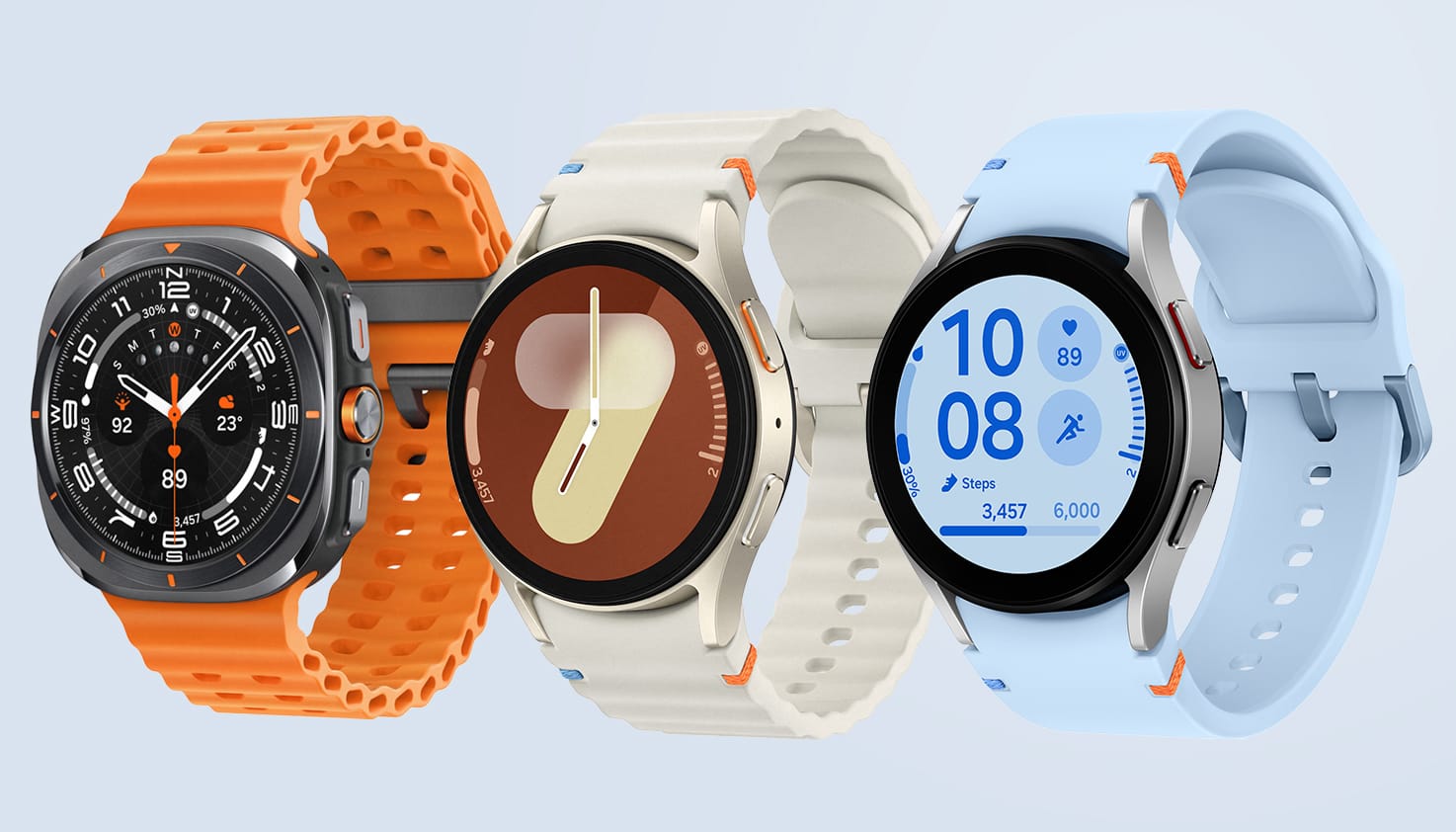
In terms of design, you can choose between three styles: the round, clean look of the Watch 9, the rounded square "squircle" shape of the Ultra 2, and the classic round case with rotating bezel of the Watch 8 Classic. Colours vary by model and season; the Watch 9 and Watch 8 are generally available in multiple colours, whilst the Classic and Ultra 2 offer a more limited, premium colour selection.

The best Samsung smartwatch for women
A "women's watch" doesn't really exist within the Galaxy Watch range: Samsung doesn't make a separate model for women, but it does offer sizes that fit a slimmer wrist more comfortably. If you have a smaller wrist, start by looking at the 40 mm version of the Watch 9 or Watch 8. It's the lightest option, which also makes it the most comfortable to wear during a night of sleep tracking. If you'd prefer something with a slightly more elegant, classic look, the Watch 8 Classic in 46 mm is still worth considering, though it's considerably heavier than the smallest Watch 9. Beyond size, colour and watch strap often make more difference to the overall look than the case dimensions themselves; swap the strap and you change the entire character of the watch.

The best Samsung smartwatch for counting steps
Every Galaxy Watch counts steps, so you don't necessarily need the most expensive model for basic step tracking. Here's how to choose based on what else matters to you:
Best value: the Galaxy Watch FE counts steps, monitors your heart rate and tracks your sleep at the lowest price in the range.
Lightest option: the Galaxy Watch 9 in 40 mm is the lightest smartwatch in this overview, making it ideal for all-day and all-night wear.
More than just steps: if you want detailed training analysis as well, the Watch 9 or Ultra 2 is a more logical choice than the FE, which focuses primarily on the basics.
If you only need a simple activity tracker without apps or notifications, a Galaxy Fit is often more than enough and considerably more affordable than a full Galaxy Watch.
How has the range evolved over the years?
A brief overview of the most significant milestones in the Galaxy Watch's history:
-
Galaxy Watch 4: the switch to Wear OS, Samsung's operating system developed together with Google. This was the first time the Galaxy Watch became truly well-suited to third-party apps.
-
Galaxy Watch 5 and 6: refinements to battery life, the display and health sensors, without any major changes in direction.
-
Galaxy Watch 6 Classic: the return of the rotating bezel, after it was dropped in earlier generations.
-
Galaxy Watch Ultra: the introduction of a rugged, sport-focused model alongside the standard range, with a much larger battery and a titanium casing.
-
Galaxy Watch 8 series: deeper integration of Galaxy AI features and health insights, with the Watch 8 Classic carrying on the rotating bezel tradition.
-
Galaxy Watch 9 and Ultra 2: a new chip, a brighter display and, on the Ultra 2, official dive certification.
If you currently own a Watch 5, 6 or 7, an upgrade is usually only worth it if your battery life has noticeably deteriorated or you really want the latest features. For everyday use, step tracking and notifications, the most recent generations differ less from one another than the product names might suggest.
Galaxy Watch with LTE or Bluetooth: which do you need?
A Samsung Galaxy Watch with Bluetooth always works alongside your phone when it's nearby: notifications, messages and calls all run through that connection. An LTE version has its own SIM card (usually an eSIM) and works independently of your phone, for example when you're out for a run. LTE does come at a higher upfront price, plus a monthly fee with your network provider.
Does a Samsung Galaxy Watch work with an iPhone?
No, not well. All recent Galaxy Watch models, from the Watch 4 to the Watch Ultra 2, run on Wear OS. This operating system does not support iPhones. If you do pair a Galaxy Watch with an iPhone, key features become unavailable, including ECG and blood pressure monitoring, replying to messages and access to the Galaxy Store. If you use an iPhone, an Apple Watch or a brand-independent smartwatch is a more sensible choice than a Samsung Galaxy Watch.
Accessories for your new Galaxy Watch
Made your choice? The smart next step is to protect and personalise your Samsung Watch straight away. Think about a sturdy watch strap for everyday wear or specifically for sport. A screen protector is essential to keep that crisp display free from scratches.
In short: which Samsung Galaxy Watch is the best?
There is no single best Samsung Galaxy Watch for everyone, but there is a clear best choice for each situation. Just want a modern, reliable smartwatch without any fuss? Go for the Galaxy Watch 9. Do you train seriously or head out into the great outdoors? The Galaxy Watch Ultra 2 is the one to go for, thanks to its longer battery life and dive certification. Prefer a classic look with a rotating bezel? Choose the Galaxy Watch 8 Classic. And if you mainly want to track steps and see notifications at a keen price, the Watch 8, the Watch FE or a Galaxy Fit are all worth considering.
Frequently asked questions about the Samsung Galaxy Watch
Which Samsung Galaxy Watch is the best?
It depends on how you use it. The Galaxy Watch 9 is the best all-round choice, the Ultra 2 comes out on top for sport and outdoor use, the Watch 8 Classic suits fans of a classic watch design, and the Watch 8 or Watch FE are ideal for a smaller budget.
What is the difference between the Galaxy Watch 9 and the Watch 8?
The Watch 9 has a newer, faster chip, but is almost identical in size and weight to the Watch 8. The differences in battery life and screen brightness are minor. For everyday use, you'll barely notice a difference, but the Watch 9 feels slightly snappier and receives software updates for longer.
Is the Galaxy Watch Ultra 2 worth the extra money?
Only if you actually use what it offers: a much longer battery life, a brighter screen outdoors, and dive certification. If you mainly use your smartwatch for notifications and a daily walk, you'll be paying for features you rarely touch.
Which Samsung Watch has the best battery?
The Galaxy Watch Ultra 2, with 800 mAh and up to 80 hours of use without always-on display. Switch on GPS, always-on display, and workouts regularly, and that figure will fall noticeably short of the quoted hours in practice.
How long does it take to charge a Galaxy Watch?
Most models charge fully in around an hour and a half. If you need a quick top-up, only the Ultra 2 supports fast charging: it reaches around 40% in roughly 30 minutes.
What is the cheapest Samsung Galaxy Watch?
The Galaxy Watch FE, with a recommended retail price from £219. There are trade-offs, though: a smaller battery and less advanced sensors compared to the pricier models.
Can you shower and swim with a Samsung Galaxy Watch?
Yes, all current Galaxy Watch models are water-resistant enough for showering and swimming in a pool or lake. Only the Ultra 2 is additionally certified for recreational diving to 40 metres; the other models are not designed for that, even if they handle the occasional splash without issue.
Does a Galaxy Watch work with an iPhone?
Not well. Galaxy Watch models run Wear OS, which does not support iPhones. Key features will be unavailable as a result. If you have an iPhone, an Apple Watch is the better choice.
Do straps from my old Galaxy Watch fit the Watch 9?
It depends on which model you're coming from. Most Galaxy Watch models up to and including the Watch 7 use a standard 20 mm strap connector, so straps from earlier generations will fit. The Watch 8 and 9 have a new connector, meaning they are not compatible with straps from earlier generations.
The Watch Ultra 2 has its own, wider strap system, so straps from other models will not fit. If you have straps from the Samsung Watch Ultra (2024 or 2025), those will fit the Ultra 2.